

- Home
- News and Stories
-
"This Is My Second Home" – The Nurse Who Refuses to Leave Her Patients Behind
"This Is My Second Home" – The Nurse Who Refuses to Leave Her Patients Behind
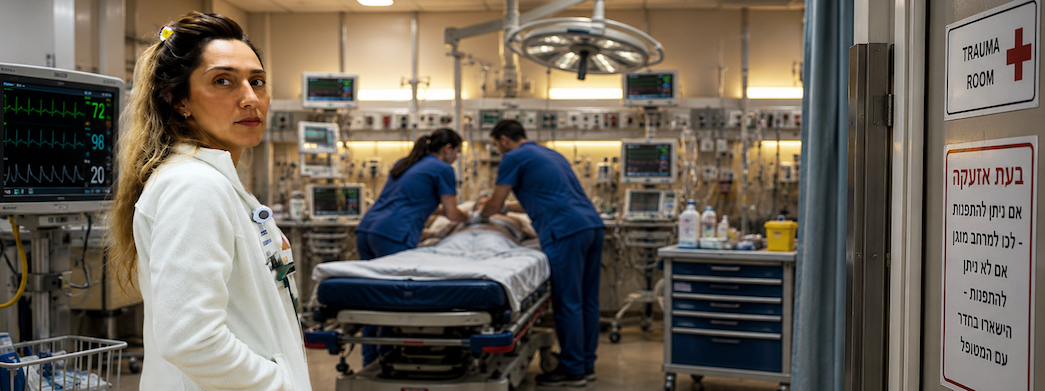
When the missile sirens sound over Netanya, patients at Laniado Hospital have only moments to seek safety.
Those who are well enough can make their way to the nearest shelter.
But many cannot.
For the critically ill lying in the Emergency Department, there is nowhere to go.
So the nurses stay with them.
"We stay with them to protect them," says Hadass, Head Nurse of Laniado Hospital's Emergency Department.
"It's very scary."
It is a simple statement, spoken without drama. Yet it perfectly captures the extraordinary reality facing the doctors and nurses at Laniado Hospital.
For almost three years, Israel has lived under the constant threat of war. Missile attacks have become part of daily life. Every siren brings impossible decisions.
Unlike many modern hospital departments, Laniado's current Emergency Department has no protected treatment area. While patients who are able to walk can be moved to safety, those connected to life-saving equipment or too critically ill to move must remain where they are.
And the staff refuse to leave them.
"When the sirens sound, the patients who cannot move stay in their beds," Hadass explains. "The staff stay with them."
Her voice pauses.
"It is very scary."
The memory of the devastating missile strike on Soroka Medical Centre still weighs heavily on healthcare workers across Israel. They know that what happened there could happen anywhere.
Yet despite the risks, the nurses never considered abandoning their patients.
"Our nurses decided to stay," Hadass says quietly. "To sacrifice themselves."
It is impossible not to be moved by those words.
Remarkably, nursing was not Hadass's first career. Before joining Laniado, she owned her own design business. Eight years ago, she chose a completely different path, dedicating her life to caring for others.
Today she leads one of the busiest Emergency Departments in Israel.
The new Sheltered Emergency Hospital will transform that reality.
Despite limited space, increasing patient numbers and the ongoing pressures of war, Laniado's Emergency Department continues to treat thousands of patients every year. According to Hadass, it is among the busiest emergency departments in the country when patient numbers are compared with the size of the department and the staffing available.
The new Sheltered Emergency Hospital will transform that reality.
Not only will it provide significantly more space for patients and staff, but for the first time the Emergency Department itself will be fully protected from missile attacks.
"It's very important that it will be protected," Hadass says. "In Israel, unfortunately, you don't know what will happen every day."
For those working on the frontline, this is not about convenience.
It is about being able to continue treating the sick and injured without choosing between their patients' lives and their own safety.
Yet perhaps the most powerful moment of the conversation came when Hadass was asked what makes Laniado different.
Without hesitation, she smiled.
"This is my second home."
She speaks of warmth.
Of compassion.
Of genuine love for patients.
"There is a connection here," she says. "Something very unique."
Founded 50 years ago by the Klausenberger Rebbe, himself a Holocaust survivor who believed every person deserved compassionate medical care, Laniado Hospital was built on the principle that medicine should treat the whole person, not just their illness.
Half a century later, that philosophy is still visible in every corridor, every ward and every member of staff.
As missiles continue to threaten northern Israel, the doctors and nurses of Laniado continue to do what they have always done: put their patients first.
Because for people like Hadass, Laniado is far more than a workplace.
It is home.
(Credit to Head Nurse Hadas Castro)
Other News
Laniado Hospital Represented at UK MedEx Conference
Laniado Hospital Performs First Balloon PFA Treatment for Atrial Fibrillation in Israel

Running Chicago for Laniado: 15 Runners, One Life-Saving Mission