

As Succot approaches, a remarkable story from the first Jewish festivals after the Holocaust carries a special meaning for everyone connected with Laniado Hospital.
On Monday 17 September 1945, Yom Kippur, General Dwight D. Eisenhower visited Feldafing, a displaced persons camp near Munich. Only four months had passed since the defeat of Nazi Germany. Thousands of Jewish survivors remained in camps across the American zone, homeless and waiting for somewhere to rebuild their lives.
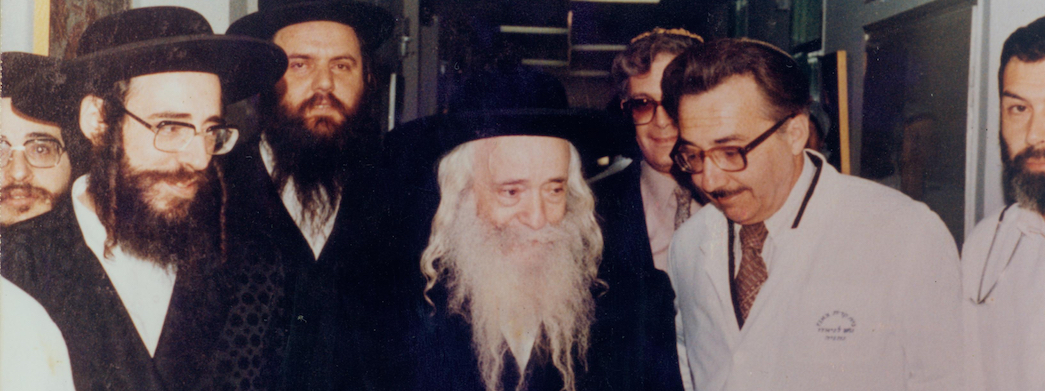
Among them was Rabbi Yekusiel Yehuda Halberstam, the Klausenburger Rebbe and future founder of Laniado Hospital. The Rebbe had survived ghettos, Auschwitz, forced labour and death marches. His wife and eleven children had been murdered. Yet in Feldafing he was already turning his attention to other survivors: feeding them, restoring religious life, establishing schools and yeshivot, helping agunot and encouraging people to marry and begin families again.
A meeting on Yom Kippur
Eisenhower’s visit was part of an official inspection of conditions in the displaced persons camps. Archival footage held by the United States Holocaust Memorial Museum confirms that he toured Feldafing with Generals George Patton and Lewis Craig. The following day, Eisenhower wrote to President Harry S. Truman about what he had seen in five camps, including two that were exclusively Jewish.
The encounter between Eisenhower and the Rebbe has been preserved through survivor testimony and later accounts.
One widely repeated account says that the general arrived while the Rebbe was still praying. The Rebbe did not interrupt his prayers to receive him. Afterwards, he is said to have explained that he had been standing before the “General of generals, the King of kings”, and therefore the earthly general had to wait.
A more detailed oral history comes through Moshe Reich, whose father-in-law, Rabbi Yaakov Yitzchak Barminka, was with the Rebbe in Auschwitz and Feldafing. According to that testimony, different groups in the camp disagreed over who should address Eisenhower and chose the Rebbe as a compromise. Wearing his tallit, the Rebbe spoke in Yiddish about the suffering of Europe’s Jews and challenged the Allies over their failure to bomb the railway lines and killing facilities at Auschwitz. Lieutenant Meyer Birnbaum, an Orthodox Jewish American soldier, translated for Eisenhower. Reich recalled being told that the general had tears in his eyes when the Rebbe finished. Then Eisenhower asked what the Rebbe needed.
He might have asked for something for himself: a visa, money or a route out of Germany. Instead, with Succot only four days away, he asked for the arba minim, the Four Species, so that the survivors could fulfil the mitzvah of lulav and etrog.
According to Barminka’s account, Eisenhower arranged for a set to be sent and it reached the Rebbe before Yom Tov began. A later published account adds that the Rebbe also asked for a jeep to support the educational and rehabilitation work he was organising across the DP camps.
The two requests, spiritual and practical, belonged to the same vision. The survivors needed food, shelter and transport. They also needed the confidence to live as Jews again. The Rebbe understood that rebuilding meant restoring both body and soul.
Rebuilding from the ashes
In the two years after liberation, the Rebbe worked across the DP camps under the banner of She’eris Hapleitah, “the surviving remnant”. He helped establish yeshivot, schools, mikvaot and soup kitchens. He supported young survivors who had lost their families and helped create the conditions in which Jewish homes could be built again.
The request for the Four Species was therefore more than the search for a scarce religious object. On the first Succot after the Shoah, taking the lulav and etrog was an act of survival, continuity and hope. It declared that a people stripped of almost everything would not surrender its faith or its future.
That same belief would eventually take physical form in Netanya.
The Rebbe later related that, after being shot and wounded during the war, he feared entering a Nazi infirmary because he did not expect to leave it alive. He used a leaf to help stop the bleeding and made a promise: if he survived, he would establish a hospital in Israel where every person would be treated with dignity, without regard to who they were or where they came from.
After years of planning, building and fundraising, Laniado Hospital opened in 1976. Its first maternity ward was especially significant to the Rebbe. After the murder of his own family, every new life represented what he called his answer to the Nazis.
Today, Laniado continues to treat all who come through its doors according to the principles he set: respect for life, compassion for every patient and the highest possible standard of care.
A hospital in Netanya where life would always be treated as sacred.
The message of Succot
Succot in 2026 begins on Friday evening, 25 September. Eighty-one years earlier, the first day of Succot also fell on Shabbat. In Feldafing, survivors who had endured ghettos, camps and death marches were able once again to hold the Four Species and make a blessing.
The story of the Rebbe’s request reminds us what rebuilding truly means. It begins with the needs immediately in front of us, but it refuses to stop there. A set of the Four Species for a broken community. A jeep to reach the next group of survivors. A hospital in Netanya where life would always be treated as sacred.
From the DP camps to Laniado Hospital, the Rebbe’s answer to destruction was to rebuild, to heal and to choose life.
Other News
Laniado Hospital Represented at UK MedEx Conference

Laniado Hospital Performs First Balloon PFA Treatment for Atrial Fibrillation in Israel
Running Chicago for Laniado: 15 Runners, One Life-Saving Mission